
Ardenok
01 / Foundation Notes

The Ardenok
Origin.

A journal built on the conviction that men's well-being deserves the same editorial care as any other serious subject — researched carefully, written plainly, and always honest about the limits of what it knows.

Portrait of an Indonesian man in his late 30s seated at a large wooden desk covered with printed research papers and a notebook, editorial office with dark walls and low warm lighting

Jakarta, 2022 — Founding Year

02 / Origin

A question about what men actually read.

Ardenok began as a private project in 2022, during a period when the available men's wellness content in Indonesia fell into two unsatisfying categories: surface-level lifestyle copy that cited nothing, or dense academic literature that required a research background to navigate.

The founding editor — with a background in nutrition science and a working life spent in Jakarta — began compiling annotated reading notes for a small group of peers. The format proved useful. By 2023 it had become a regular publication, and Ardenok was formalised as an independent editorial activity.

The journal has no commercial supplement interests. It does not sell formulations, endorse brand partnerships, or receive revenue from product placement. The editorial independence this affords is considered a structural necessity, not a marketing claim.

"The best wellness writing tells you what the evidence shows, what it does not show, and why that distinction matters in the context of a real week."

— Ardenok Editorial Charter, 2022
03 / Editorial Values

What this journal stands for.

01

Accuracy Before Accessibility

Where the research is unclear, Ardenok says so. Where a claim is contested, competing positions are acknowledged. Simplification is a tool for communication, not a method for making weak conclusions sound confident. Every entry reflects the actual state of the literature it draws from.

02

Context as Editorial Responsibility

A recommendation written for a temperate climate, a specific dietary tradition, or a particular work pattern does not transfer automatically to the Jakarta context. Ardenok adapts source material to the actual environment its readers inhabit — heat, food culture, urban pace, and the specific pressures of Indonesian professional life.

03

Sustainability Over Intensity

The habits that last are built on modest, durable decisions rather than large, unsustainable ones. This journal has a structural preference for sustainable health practices — routines that work within ordinary constraints rather than requiring extraordinary conditions to function.

04 / The Team

Small editorial team. Large research network.

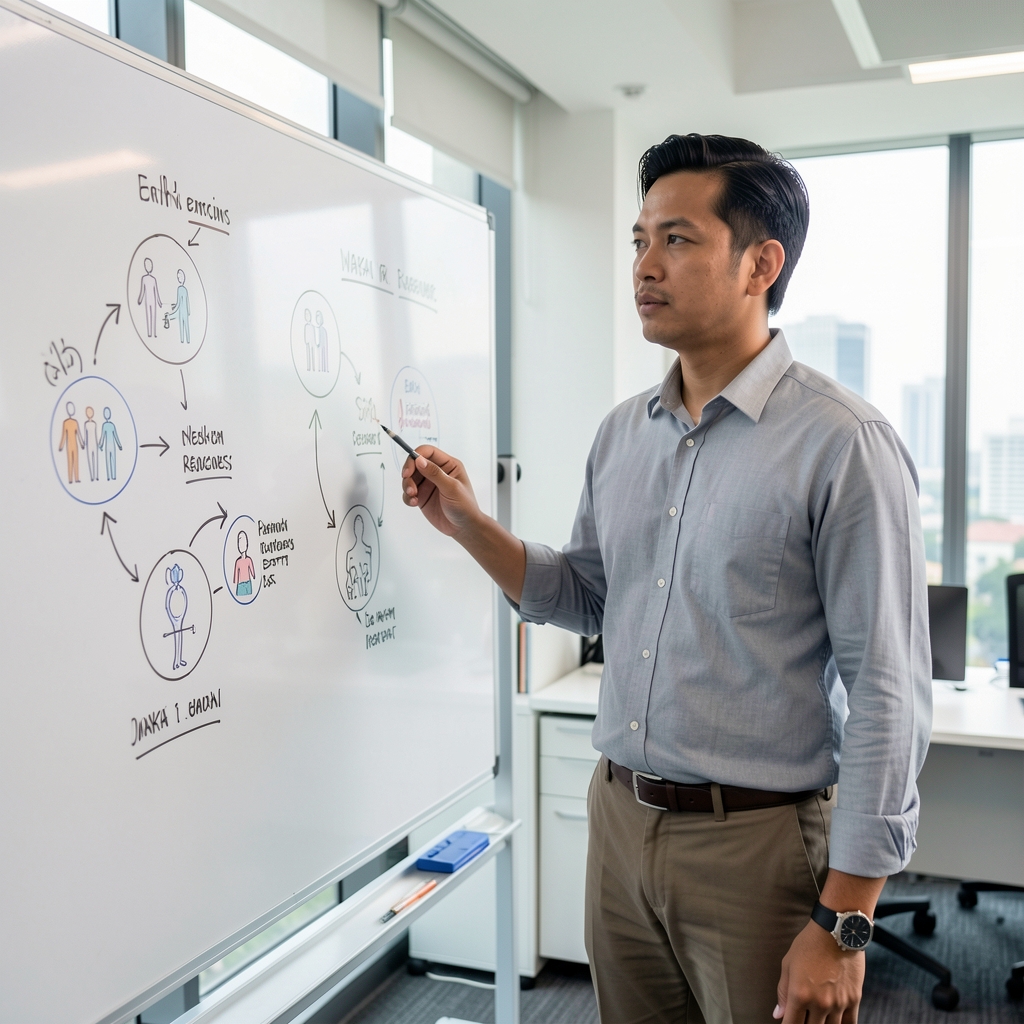
Indonesian man in professional casual attire standing at a bright whiteboard covered in wellness research diagrams, thoughtful expression, Jakarta office

Rafi Andrianto

Founding Editor

Nutrition science background. Seven years of editorial experience across regional wellness publications before founding Ardenok in 2022. Based permanently in Jakarta's South district.

Indonesian woman in her early 30s reviewing a printed nutrition research paper at a bright editorial desk, professional attire, natural light from a Jakarta window

Sari Wulandari

Research & Verification Lead

Qualified nutrition professional with a specialisation in food science. Responsible for cross-referencing editorial claims against the published literature and maintaining source documentation.

Indonesian man in athletic wear stretching outdoors near a Jakarta park trail, mid-morning light, notebook tucked under arm, active lifestyle and wellness professional

Teguh Prasetyo

Fitness & Movement Contributor

Certified strength and conditioning specialist. Contributes entries covering functional fitness, body composition awareness, weekend outdoor fitness, and active recovery protocols specific to the Indonesian climate.

Indonesian man in his 40s at a standing desk with multiple monitors showing nutritional data charts and research documents, editorial office in Jakarta with clean dark interior

Hendra Kurniawan

Data & Progress Tracking Contributor

Background in applied data analysis with an interest in self-measurement, habit-consistency tracking, and the intersection of quantitative self-monitoring and sustainable well-being practices.

External Review Network

Beyond the core team, Ardenok maintains working relationships with a network of qualified wellness and nutrition professionals across Jakarta and Bandung. These professionals review entries in their area of specialisation prior to publication, providing an additional layer of factual verification that the editorial team considers a structural requirement rather than an optional enhancement.

05 / Archive Notes

Publication record.

2022

Private circulation begins

The first annotated reading notes are shared within a small group of nutrition science peers. Format: monthly summaries covering morning routine, balanced nutrition, and active recovery.

Early 2023

Ardenok formalised as an independent publication

The journal transitions from private correspondence to a structured editorial activity. The Jakarta office is established at Jl. Dharmawangsa. An editorial charter is drafted and adopted.

Mid 2023

Research verification network established

Formal relationships with qualified nutrition and wellness professionals are established to provide pre-publication review. All entries from this point forward undergo external verification before publication.

2024

Coverage expanded to eight pillar areas

The original three-pillar structure (nutrition, fitness, recovery) is broadened to eight areas, adding sleep quality, stress management, grooming and self-care, mindful eating, and progress tracking as formal categories.

2025–26

140+ entries in active archive

The journal continues at a pace of two to three entries per month. The archive is maintained and older entries revised as the literature evolves. The editorial structure, independent funding model, and no-advertising commitment remain unchanged.

06 / Next Steps

Continue into the journal.

The editorial content is organised across eight thematic areas. The Standards page describes in detail how entries are researched, reviewed, and updated.